Calming | Stress Relief | Overthinking | Focus | Mental Clarity | Meditation | Sleep | Intuition | Spiritual Awareness | Emotional Balance | Protection | Energy Cleansing | Sobriety & Self-Control | Breaking Unwanted Habits | Grief Support | Dreamwork | Third Eye | Crown ChakraAmethyst
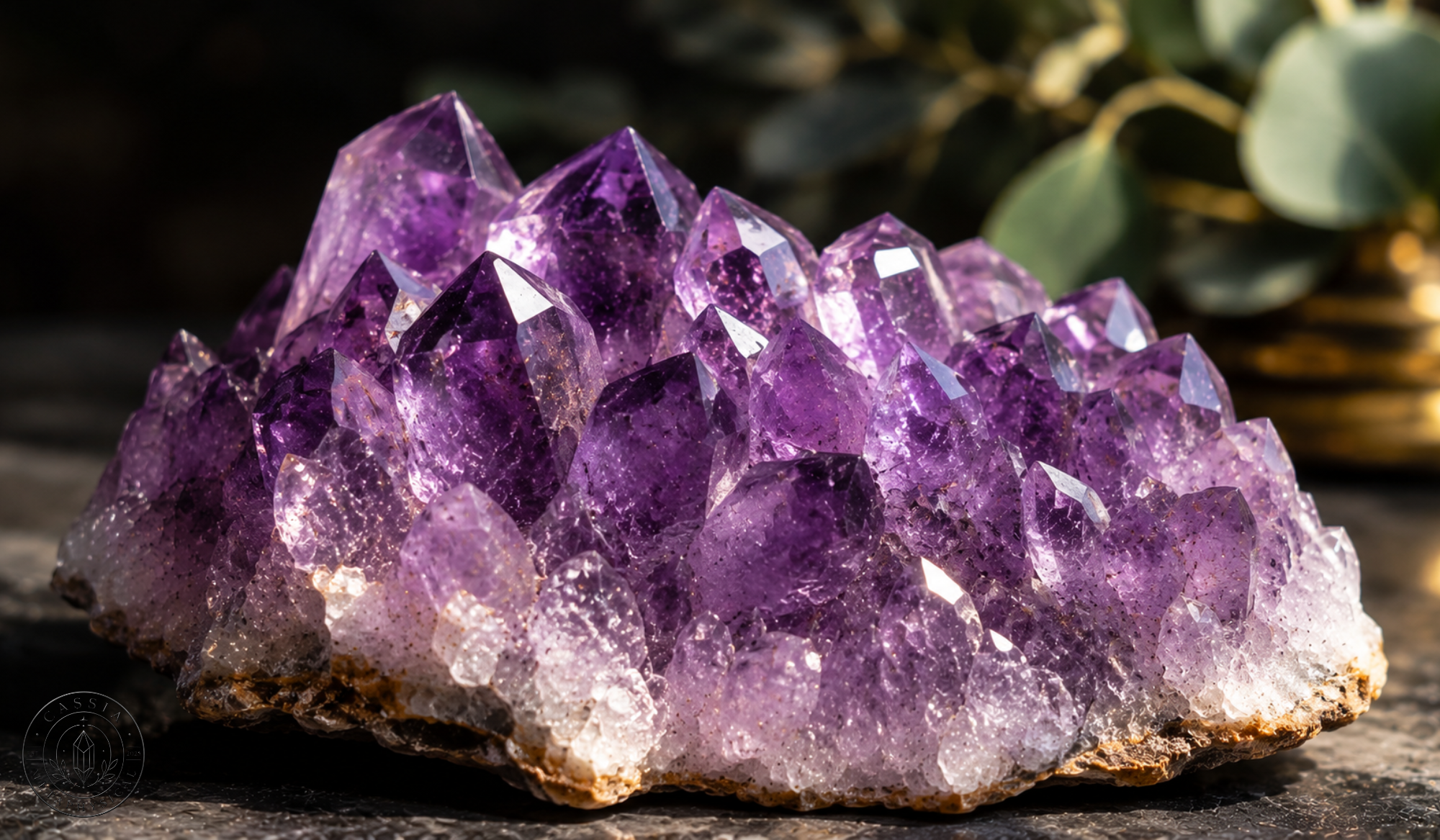
Amethyst is a purple variety of quartz and one of the most recognisable crystals in the world.
Its colour can range from very pale lavender to rich violet and deep purple, depending largely on trace iron, natural irradiation and conditions during formation.
For centuries, amethyst has been associated with a clear mind, protection and self-control. Its name comes from the Greek amethystos, meaning “not intoxicated,” reflecting the ancient belief that amethyst could help a person remain clear-headed and resist drunkenness.
Today, it is especially popular as a crystal for calming busy energy, meditation, spiritual practice and creating a peaceful environment.
Quick Reference
Mineral Family: Quartz
Chemical Formula: SiO₂
Crystal System: Trigonal
Mohs Hardness: 7
Typical Colour: Pale lavender to deep violet-purple
Lustre: Vitreous
Transparency: Transparent to translucent
Primary Chakras: Third Eye & Crown
Element: Air / Spirit
Traditional Planetary Association: Jupiter
Traditional Zodiac Associations: Pisces, Aquarius & Sagittarius
Birthstone: February
Common Intentions: Peace, clarity, protection, intuition and spiritual awareness
Metaphysical Properties
Amethyst is generally considered a calming and spiritually oriented crystal.
Rather than being associated with highly stimulating energy, it is traditionally used when someone wants to quiet mental noise while remaining clear and aware.
Amethyst is commonly worked with for:
calming a busy or overactive mind
stress support
emotional balance
mental clarity
concentration and focus
meditation
intuition
spiritual development
energetic protection
cleansing unwanted or stagnant energy
creating peaceful environments
sleep rituals
dreamwork
grief and emotional transitions
self-control
breaking unwanted patterns or habits
maintaining clear intentions
developing greater awareness of thoughts and emotions
Its combination of calmness and clarity is one reason amethyst has remained one of the most widely used crystals in contemporary metaphysical practice.
Mental Focus, ADHD & Learning
Amethyst is sometimes used as a supportive crystal by people who experience mental overstimulation, distractibility, racing thoughts or difficulty settling into focused work.
For studying or learning, its metaphysical symbolism centres around:
Focus | Mental Clarity | Calm Concentration | Reducing Distraction | Memory Rituals | Study Environments
Some people with ADHD find calming objects, tactile stones or intentional rituals helpful for creating a transition into focused work. Amethyst can be incorporated into that kind of personal practice.
However, amethyst has not been scientifically demonstrated to treat ADHD, learning disabilities or cognitive disorders and should not be presented as a medical treatment.
Emotional Properties
Emotionally, amethyst is traditionally associated with peace without emotional numbness.
It is often chosen during periods of:
overwhelm
stress
grief
emotional exhaustion
major transitions
overthinking
difficulty letting go
heightened emotional sensitivity
Amethyst can serve as a physical reminder to slow down before reacting and give yourself enough space to understand what you're actually feeling.
For this reason, it is frequently kept in bedrooms, counselling spaces, healing rooms and meditation areas.
Stress & Anxiety Support
Amethyst has a strong traditional reputation as a calming stone and is commonly included in crystal practices intended to support relaxation.
People may hold amethyst during breathing exercises, meditation or grounding practices when feeling stressed or anxious.
The important distinction is that amethyst does not medically treat anxiety disorders.
Its role is better understood as a symbolic or mindfulness tool that can become part of a person's calming routine.
Sleep & Dreamwork
Amethyst is one of the most commonly used crystals in metaphysical sleep practices.
It is traditionally placed:
Beside the bed | On a nightstand | Under a pillow | Near a meditation area
People work with it symbolically for:
quieting thoughts before sleep
creating a peaceful bedroom environment
dream recall
dream journaling
intuitive dreams
nighttime meditation
People who find crystals stimulating rather than calming may prefer keeping larger specimens farther away from the bed.
Spiritual Properties
Amethyst has been associated with spirituality and contemplation for centuries.
In contemporary spiritual practices it is frequently used for:
Meditation | Intuitive Development | Spiritual Awareness | Energy Work | Dreamwork | Visualization | Connecting With Guides | Higher Consciousness
Its association with mental quietness makes it especially popular for meditation because the intention isn't necessarily to “receive” something, it can simply be used as a reminder to become still enough to observe.
Intuition & Psychic Development
Amethyst's traditional connection with the Third Eye Chakra has made it one of the most popular crystals for intuitive practices.
Practitioners may use it while:
reading tarot or oracle cards
journaling
meditating
practising visualization
developing intuitive awareness
recording dreams
performing energy work
These uses belong to spiritual and metaphysical traditions rather than scientifically established properties of the mineral.
Protection & Energy Cleansing
Amethyst has historically developed a reputation as a protective stone.
In modern crystal practices it is commonly placed in homes and spiritual spaces with the intention of:
Energetic Protection | Clearing Heavy Energy | Maintaining Peace | Strengthening Boundaries | Creating Sacred Space
Large clusters and geodes are especially popular for this purpose.
Unlike grounding stones such as black tourmaline, amethyst's protective symbolism tends to focus more on clarity and maintaining a peaceful energetic environment.
Sobriety & Self-Control
This is one of the most historically interesting associations of amethyst.
The name amethyst comes through Greek amethystos, traditionally interpreted as “not intoxicated.”
Ancient beliefs connected the stone with protection from drunkenness and maintaining a clear mind.
This history is why amethyst remains symbolically associated with:
Sobriety | Moderation | Self-Control | Clear Thinking | Breaking Unwanted Habits
Amethyst should not, however, be considered a treatment for substance-use disorders or addiction, but a tool to use alongside.
Chakras
Third Eye Chakra
Located symbolically between the eyebrows, the Third Eye Chakra is associated in chakra traditions with:
Intuition | Perception | Awareness | Inner Knowing | Mental Clarity
Amethyst is one of the crystals most commonly associated with this chakra.
Crown Chakra
The Crown Chakra is associated with:
Consciousness | Spiritual Awareness | Connection | Higher Perspective
Very pale lavender, violet and exceptionally clear amethyst are particularly popular for Crown Chakra practices.
Zodiac Associations
Amethyst is most commonly associated in modern crystal traditions with:
Pisces | Aquarius | Sagittarius
Different metaphysical traditions may assign additional zodiac correspondences.
You do not need to belong to one of these zodiac signs to use or enjoy amethyst.
Birthstone
Amethyst is the traditional and modern birthstone for February.
It is also traditionally associated with the sixth wedding anniversary.
Element Association
Amethyst is most commonly associated metaphysically with:
Air & Spirit
Air represents thought, clarity and awareness, while Spirit represents consciousness and spiritual connection.
Elemental correspondences vary between traditions.
How to Use Amethyst
For Calm
Hold a tumbled amethyst while taking several slow breaths and intentionally allowing your attention to return to the present moment.
For Studying
Keep a small piece beside your computer, notebook or study materials as a visual cue that it's time to focus.
For Meditation
Hold amethyst or place it in front of you while meditating.
For Sleep
Place a small specimen on your nightstand, under your pillow, or even bed, as part of your nighttime routine.
For Intuition
Keep amethyst nearby during journaling, tarot, oracle work or other intuitive practices.
For Your Home
Place larger clusters or geodes in areas where you want to create a visually peaceful focal point.
Where to Place Amethyst in the Home
Bedroom : rest and peaceful atmosphere
Meditation Space : stillness and spiritual practice
Healing Room : calm and energetic intention
Office or Study Area : concentration and mental clarity
Living Room : peaceful atmosphere and statement specimen
Entrance : traditionally used for energetic protection
Crystal Pairings
Amethyst + Clear Quartz
Clarity | Amplification | Meditation
Amethyst + Rose Quartz
Emotional Healing | Compassion | Peace
Amethyst + Black Tourmaline
Protection | Grounding | Energetic Boundaries
Amethyst + Selenite
Cleansing | Meditation | Spiritual Awareness
Amethyst + Labradorite
Intuition | Transformation | Spiritual Exploration
Amethyst + Lepidolite
Calm | Emotional Balance | Quieting Busy Energy
Amethyst + Smoky Quartz
Grounding | Calm | Releasing Heavy Energy
Collecting & Buying Tips
When choosing amethyst, look beyond simply asking which piece has the darkest colour.
Consider:
Colour | Crystal Formation | Clarity | Inclusions | Origin | Size | Natural Shape | Overall Beauty
Collectors may value unusual formations, locality, exceptional clarity, deep colour or interesting mineral inclusions.
There is no single “best” amethyst. A pale lavender specimen can be every bit as beautiful and interesting as a deep-purple one.
History & Folklore
Amethyst has been used by humans for thousands of years.
Its historical associations include:
Clarity | Sobriety | Protection | Royalty | Spirituality | Religious Devotion
Purple has historically been an expensive and prestigious colour, which contributed to amethyst's association with royalty and religious authority.
Amethyst appears in historical jewellery, ceremonial objects and religious collections across multiple cultures.
Good to Know
Amethyst is:
Natural Quartz
February Birthstone
Mohs 7
Purple Due to Colour Centres Involving Iron
Sensitive to Prolonged Strong Sunlight
It is one of the best crystals for someone beginning a collection because it combines fascinating geology, extensive history, beautiful natural formations and a very large body of metaphysical tradition.
A Note About Crystal Healing: The metaphysical information in the Cassia Metaphysical Crystal Library reflects historical traditions, folklore, spiritual practices and contemporary crystal beliefs.Scientific evidence does not establish crystals as treatments for medical or mental-health conditions. References to calming, anxiety, ADHD, sleep, emotional healing or other wellness uses describe traditional or personal spiritual practices rather than medical effects.Crystals can be enjoyed as minerals, collectibles, symbolic objects and tools within personal spiritual or mindfulness practices, but they should not replace appropriate professional healthcare.